The Crimean Khanate: History, Map and Crimean Tatar Statehood
English text prepared with AI assistance and reviewed by a separate AI agent. Editorial process and limits.
The Crimean Khanate was a state ruled by the Giray dynasty, with its heartland in Crimea and connections across the northern Black Sea steppe. Its conventional span, 1441–1783, runs from its fifteenth-century formation to Russian imperial annexation. It is central to Crimean Tatar political history, although its dynastic government and changing allegiances were different from a modern nation-state. İnalcık, opening and foundation paragraphs; Kırımlı, p. 751.
Origins and the Giray Dynasty
The khanate emerged from struggles within the fragmenting Golden Horde. Hacı Giray established a separate centre of power in the early 1440s; İnalcık dates the earliest surviving coin bearing his name to 1441–1442. That makes 1441 a useful conventional starting point, rather than proof of instant, uncontested authority over every later dependency. İnalcık, Hacı Giray foundation paragraph.
Giray rulers drew legitimacy from descent from Chinggis Khan and the political traditions of the steppe. Their success also depended on powerful clan leaders. Fisher emphasizes the rivalries that shaped the early state and the contested succession after Hacı Giray’s death; the dynasty did not operate through automatic, peaceful inheritance. Fisher, pp. 1 and 7–8.
Government and Society
The khan governed with dynastic deputies, including the qalğa/kalgay and nureddin, and a divan, or governing council. Leading clan aristocrats, especially the Şirin, held substantial power. Nogay groups outside the peninsula had their own leaders and shifting relationships with the khan. These arrangements should not be pictured as uniform administration from a modern capital. Halenko, pp. 114–115.
Islamic scholars and institutions also mattered. The mufti and judicial officials participated in government; qadis handled judicial and civil business, and madrasas provided Islamic learning. Religious authority existed alongside dynastic and clan power. İnalcık, Teşkilât, council and ulema paragraphs.
Life included agriculture, herding, orchards, crafts and trade, with different patterns between steppe communities and towns. Crimean society also included Greek, Armenian and Jewish communities. Its history cannot be reduced either to an idyllic court culture or to a population engaged in warfare alone. Crimea, historical society and economy paragraphs.
Raiding, captivity and slavery were substantial parts of this world. Crimean and Nogay forces seized people in neighbouring territories; captives could be sold, put to work or held for ransom. Kizilov’s study compares Christian, Muslim and Jewish accounts and shows the importance of the slave trade within Crimea and through Ottoman ports. Such evidence also needs criticism: some travellers’ huge numerical claims are explicitly unreliable. This overview therefore gives no unsupported total of victims. Kizilov, pp. 2 and 6–8, especially notes 8–11.
Where Was the Crimean Khanate?
The khanate’s reach extended beyond the peninsula into the northern Black Sea steppe and the Kuban region. Political allegiance varied across those territories. Meanwhile, important Crimean coastal centres and their districts were under direct Ottoman administration after 1475. A single outline colouring the whole region identically would hide this distinction. Kırımlı, p. 751; Kizilov, p. 2.
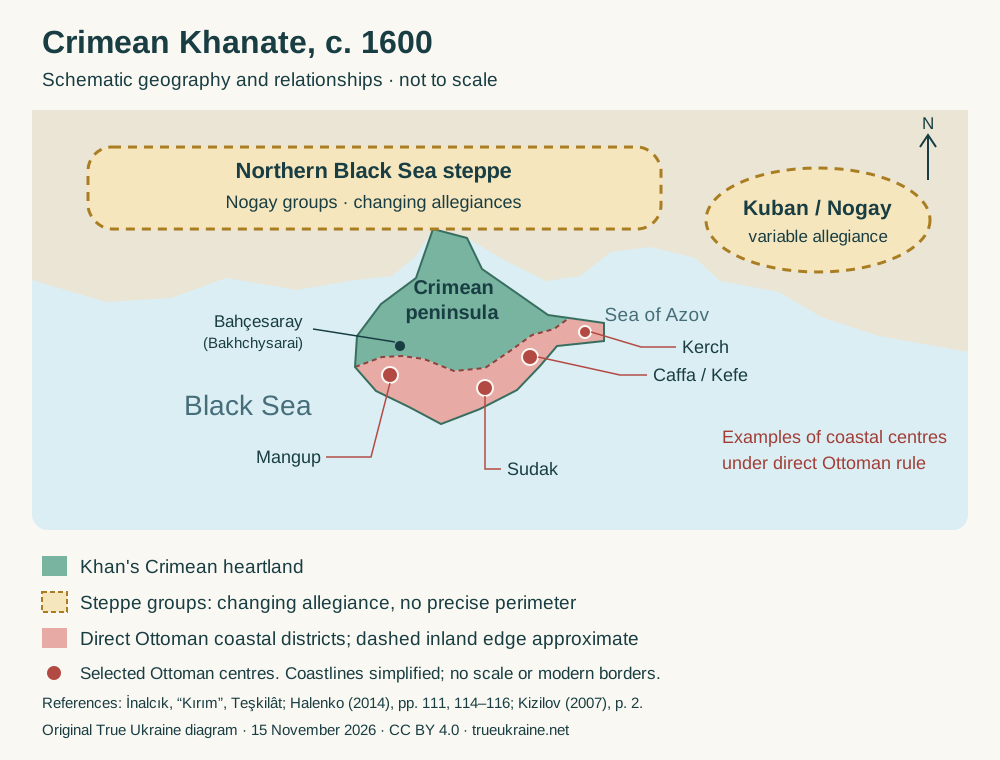
Original True Ukraine diagram, prepared 15 November 2026, CC BY 4.0. Historical reference period: circa 1600. Green identifies the khan’s Crimean heartland; the separate rose area represents directly administered Ottoman southern and eastern coastal districts. Its dashed inland edge is illustrative: the cited texts establish the coastal districts and centres, not surveyed boundaries for 1600. Red dots mark selected Ottoman centres: Mangup, Sudak, Caffa/Kefe and Kerch. Amber dashes indicate groups with variable allegiances, not a precise perimeter. Ottoman possessions outside Crimea and individual district divisions are omitted. Coastlines and distances are deliberately simplified, and no modern state borders appear. References: İnalcık, Teşkilât, first two territorial paragraphs; Halenko, pp. 111, 114–116; Kizilov, p. 2. Open the diagram at full size.
This Crimean Khanate map explains different kinds of authority; it is not a surveyed reconstruction of borders or a claim that every steppe group obeyed the khan continuously.
Relations with the Ottoman Empire and Neighbours
Ottoman suzerainty and direct annexation were different arrangements. In 1475 Ottoman forces took the southern coastal centres; Mengli Giray’s installation in 1478 consolidated a dependent relationship with the sultan. The khans nevertheless retained their own government and separate diplomacy. Fisher treats the extent of their dependence as a historical question, rather than assuming that “vassal” explains every period in the same way. Fisher, pp. 8–12.
Relations with Muscovy, Poland-Lithuania and the Cossacks combined diplomacy, payments, alliances and destructive campaigns. Under İslâm Giray III, Crimean forces allied with Bohdan Khmelnytsky’s Cossacks against the Commonwealth in 1648–1653; the khan also negotiated separately with Poland. These were changing interests, rather than a permanent ethnic alliance. İnalcık, İslâm Giray III, foreign relations paragraphs. The guide to Cossack history explains the other side of those relationships.
The 1774 Treaty of Küçük Kaynarca, Article III, formally recognized the Tatar peoples’ political independence from both empires, under their own Chinggisid khan. It distinguished that status from religious ties to the Ottoman sultan as caliph and reserved Kerch and Yenikale to Russia. A treaty’s formal promises need to be distinguished from the power exercised on the ground. Primary treaty, Article III.
Key Dates
| Date | Event and significance | Source |
|---|---|---|
| 1441–1442, conventional foundation evidence | Earliest coin bearing Hacı Giray’s name; formation was a process. | İnalcık, foundation paragraph |
| 1466 | Hacı Giray’s death was followed by rival claims to the throne. | Fisher, pp. 7–8 |
| 1475 | Ottoman conquest of southern coastal centres. | Fisher, pp. 8–12 |
| 1478 | Mengli Giray installed with Ottoman support; dependent relationship consolidated. | Fisher, p. 8 |
| 1502 | Mengli Giray defeated the Great Horde; its legacy remained part of Giray claims. | Halenko, p. 113 |
| 1648–1653 | İslâm Giray III and the Cossacks campaigned against Poland-Lithuania; diplomacy also produced separate agreements. | İnalcık, İslâm Giray III |
| 1736 | Russian forces invaded Crimea and burned Bahçesaray. | İnalcık, eighteenth-century campaigns |
| 1771 | Russian invasion and occupation intensified the struggle over Crimea’s political future. | Hrybovskyi, pp. 183–185 |
| 21 July 1774, Gregorian date | Küçük Kaynarca formally recognized independence, with territorial exceptions and religious qualifications. | Treaty, Article III |
| 1783 | Russia annexed the khanate’s territories, ending its existence as a separate state. | Kırımlı, p. 751 |
Annexation and Its Consequences
The last khan, Şahin Giray, pursued reforms while relying on Russian support. Opposition, rival claims and Russian military intervention narrowed his freedom of action. His eventual abdication preceded Catherine II’s annexation in 1783. This sequence was more complex than a peaceful change of a map’s colour. Hrybovskyi, pp. 186–188.
The consequences extended beyond the dynasty. In his study of Crimean Tatar emigration, historian Hakan Kırımlı connects annexation with imperial settlement policies, unequal treatment and a prolonged movement of Crimean Tatars to Ottoman lands. His opening discussion distinguishes the loss of political institutions from the later demographic transformation; it does not supply a single uncontested number of emigrants for the whole period. Kırımlı, pp. 751–752.
Kırımlı’s research supplies a documented Crimean Tatar historiographical perspective in this account. His Bilkent biography records his scholarly work and Crimean Tatar as a native language. His interpretation is attributed here, rather than presented as the unanimous voice of an entire people.
What This History Explains about Crimea
The khanate makes it impossible to tell Crimea’s past solely as a history of Russian rule. It also shows why Crimean Tatar statehood deserves attention in its own terms: through its institutions, communities, cultural life and interactions with neighbours. Ottoman dependence and Russian annexation are distinct historical relationships.
This past provides context; historical control alone does not settle present sovereignty or erase the rights of people living there. Continue with Crimea before and after Russian rule and the Crimea reading guide. The 1954 transfer and 2014 referendum belong to separate periods and require their own sources.
Sources
- Alan W. Fisher «The Crimean Tatars» (1978) — Hoover Institution Press
- Halil İnalcık «Kırım: Kırım Hanlığı (1441–1783)» (2022) — TDV İslâm Ansiklopedisi
- Oleksandr Halenko and Vladyslav Hrybovskyi; Valerii Smolii, editor «Crimea: A Path through the Ages. History in Questions and Answers» (2014) — Institute of History of Ukraine, National Academy of Sciences of Ukraine
- Hakan Kırımlı «Emigrations from the Crimea to the Ottoman Empire during the Crimean War» (2008) — Middle Eastern Studies 44(5), 751–773
- Bilkent University «Sırrı Hakan Kırımlı: faculty biography» (2026)
- Mikhail Kizilov «Slave Trade in the Early Modern Crimea from the Perspective of Christian, Muslim, and Jewish Sources» (2007) — Journal of Early Modern History 11(1–2), 1–31
- Halil İnalcık «İslâm Giray III» (2001) — TDV İslâm Ansiklopedisi 23, 46–47
- Russian and Ottoman plenipotentiaries «Treaty of Peace (Küçük Kaynarca), Article III» (1774) — National University of Singapore; British Parliamentary Papers, 1854, vol.72, pp.171–179
- Internet Encyclopedia of Ukraine «Crimea: history and economy» (2026)
- True Ukraine «Crimean Khanate, c.1600: original schematic geography and relationships» (2026) — True Ukraine; CC BY 4.0
Related Articles
Crimea Is Not 'Historically Russian'
Debunking the myth of 'historically Russian Crimea.' The history of the peninsula and a legal analysis of the 1954 transfer and recognition of Ukraine's borders.
'Khrushchev Drunkenly Gave Away Crimea': What Actually Happened in 1954
The truth about the 1954 transfer of Crimea: who made the decision, why, and how Russia itself recognized its legitimacy for 60 years.
The Crimean 'Referendum' of 2014: A Vote at Gunpoint
Why the 2014 Crimean 'referendum' was illegitimate: occupation, absence of observers, ballot manipulation, and the leak of real data.
Cossacks Are Not 'Russian Cossacks'
Debunking the myth that Cossacks were part of 'Russian Cossackdom.' The Zaporozhian Sich was a unique Ukrainian state formation with a democratic system of governance.